


To align our intelligence capabilities with your immediate operational needs, please identify the strategic threshold your organisation is currently facing:
-
In a landscape defined by rapid geopolitical shifts, supply chain disruptions, and highly fragmented regulatory frameworks, standard management information systems are no longer sufficient to protect your operational baseline. Whether you are managing the secondary impacts of global trade conflicts, adapting to incoming technology legislation, or navigating shifting environmental compliance mandates, informational asymmetry is your greatest threat. We translate complex, evolving external variables into structured, auditable intelligence. This provides your leadership team with a clear, tailored view of exactly what is changing, how it translates into direct business impacts, and precisely when strategic action is required.
-
Committing significant capital to new infrastructure, technology platforms, or major supply chain reconfigurations carries profound, often hidden, secondary risks. Before irreversible structural decisions are finalized, leaders require rigorous, objective scrutiny. We apply advanced intelligence tradecraft to examine proposed decisions, utilizing structured qualitative analysis and operational modeling. By mapping out the exact consequences of acting, delaying, or abstaining, we identify unintended operational knock-on effects and financial vulnerabilities before they occur, ensuring your capital allocation is resilient against future market shocks.
-
When organizational performance stalls despite heavy investment, the root cause is rarely a single departmental failure; rather, it is systemic friction across your wider value chain. Whether your enterprise is grappling with regional infrastructure bottlenecks, disconnected data silos, or highly complex operational dependencies, achieving efficiency requires total architectural visibility. We build comprehensive, structured representations of how your business actually functions, precisely detailing resource flows, information deficits, and physical points of constraint. In its most advanced form, we turn your operational architecture into a working model, allowing you to test, stress, and refine interventions before live implementation.
-
Sector-wide disruptions—such as the transition to clean energy, the integration of frontier technologies, or major shifts in public sector procurement—demand fundamental business architecture redesigns rather than incremental adjustments. However, executing a strategic pivot without destroying current revenue streams is highly perilous. For complex, rapidly evolving challenges that defy standard consultancy frameworks, we deliver targeted scenario development and bespoke intelligence. We validate your transformational roadmap, ensuring your new business model is structurally sound, economically viable, and optimally timed to capture emerging market share.
How we support your decisions
-
![]()
Situation Updates and Assessment
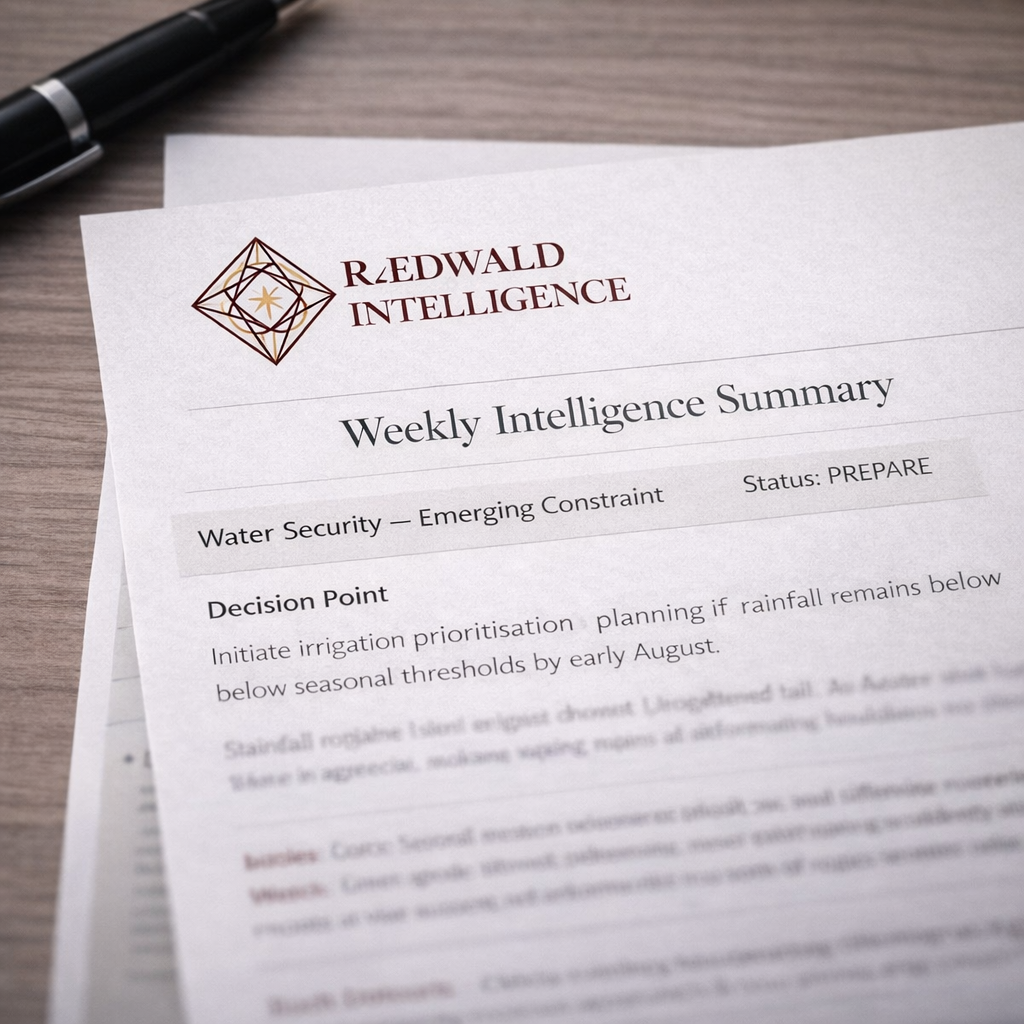
Regular situational updates on developments relevant to your organisation, including changes in news, regulation, climate, and operational constraints such as restrictions or disruptions. Updates are tailored to your context, identifying relevance, assessing implications, and defining timing and decision dependencies. They include a structured view of what is changing, what it means for your operations, what requires attention, and what should be monitored as the situation develops.
Delivered verbally or in written form at a defined frequency, depending on operational requirement.
-
![]()
Decision Trade-off Assessment
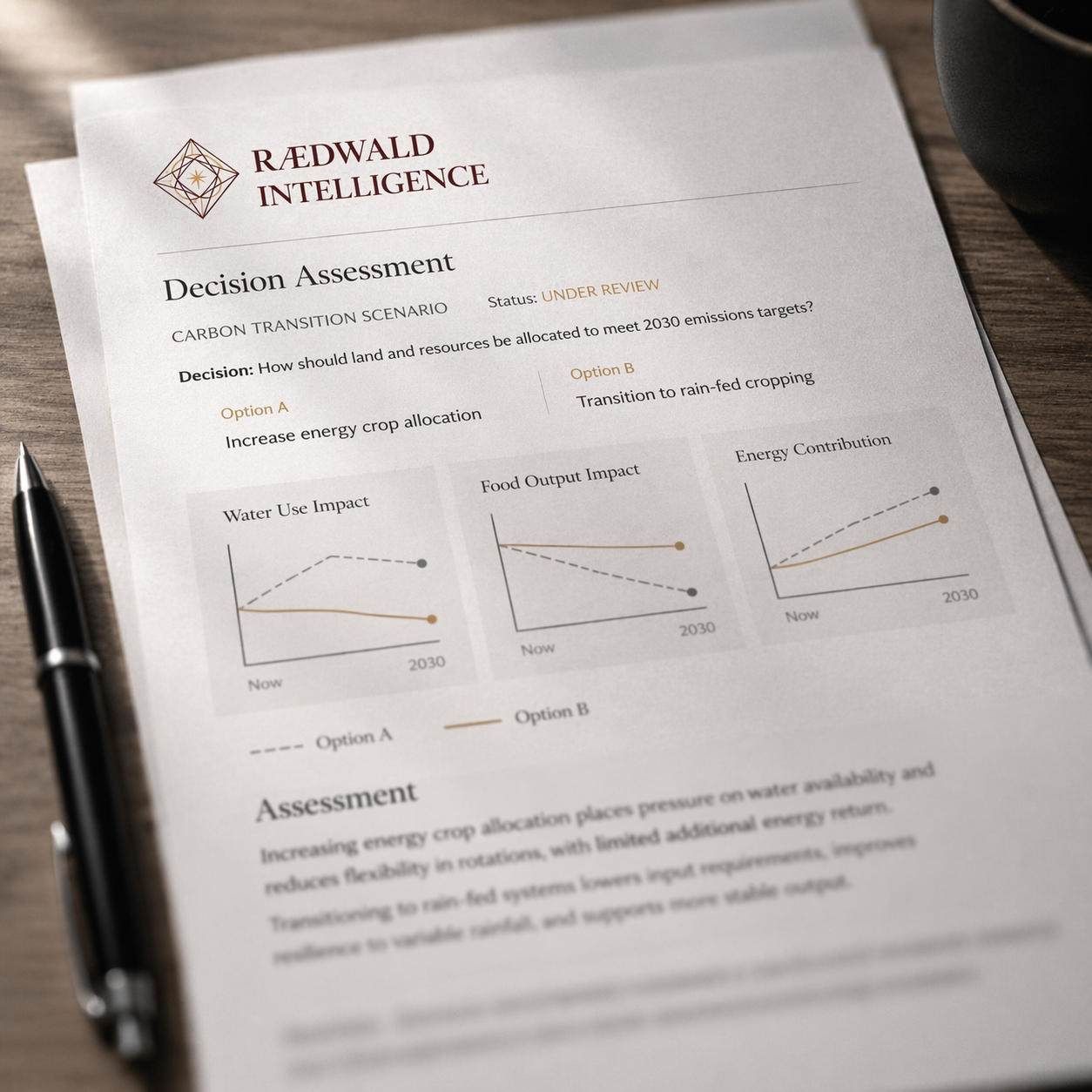
Decisions are often made under conditions of uncertainty, with limited visibility of their downstream effects. This service examines proposed decisions before they are taken, assessing how they are likely to play out across your organisation over time. This can be delivered through structured qualitative analysis or, where appropriate, more advanced modelling. It enables you to understand the consequences of acting, delaying, or not acting at all, and to identify risks and unintended effects before they occur.
-
![]()
Business Mapping and Flow Modelling
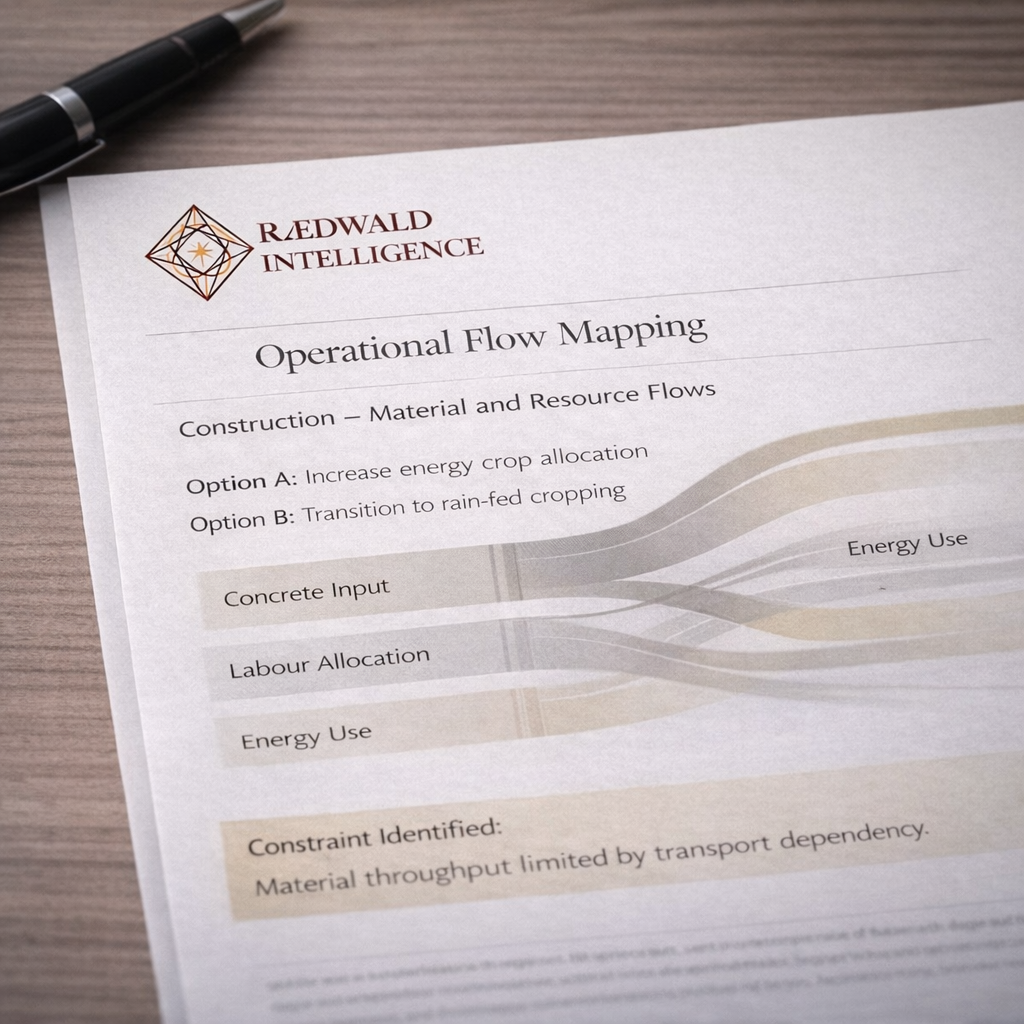
Effective decision-making depends on a clear understanding of how your organisation actually functions. This service builds a structured representation of your business, including resource flows, information flows, operational dependencies, and points of constraint. It allows you to identify bottlenecks, understand where you are most exposed to external change, and see how impacts move through your system. In its more advanced form, this becomes a working model of your organisation, enabling testing and refinement of decisions before they are implemented.
-
![]()
Bespoke Intelligence Services
Not all problems fit within predefined structures. Where your requirements are specific or evolving, intelligence can be designed around your particular context. This includes targeted assessments, scenario development, and focused analysis on issues that require deeper or more immediate attention. The aim is to provide clarity where standard approaches are insufficient, ensuring that intelligence remains directly relevant to the decisions you need to make.


Navigating Geopolitical Volatility and Regulatory Fragmentation
Situation Updates and Assessment
When geopolitical instability disrupts shipping routes or new environmental regulations are announced, the financial impact on your operational baseline is immediate. Relying on standard, end-of-month management reporting means you are reacting to yesterday's news—often after the margin has already been lost.
Our Situation Updates and Assessment service provides a continuous, highly tailored intelligence radar for your specific business context. We track and interpret the external variables that threaten your enterprise, delivering structured updates on what is changing, how it translates into direct operational friction, and precisely when strategic action is required. We do not just report the news; we define your decision timing.
The Deliverable
The Situational Intelligence Update is engineered specifically for complex commercial environments, synthesizing military intelligence doctrine with executive decision-making architecture. You will receive a rigorously structured brief containing :
An Executive BLUF (Bottom Line Up Front): Delivering the most critical assessments immediately utilizing probabilistic forecasting and exact timeframes.
A Situational Review: A multi-domain analysis that strictly separates verified ground-truth facts from assessed intelligence.
Client Impact & Decision Timelines: Mapping the external intelligence against your business architecture to identify exact confliction points and trigger events.
Alternative Futures Analysis: Replacing rigid binary models with an Indicators and Warnings (I&W) matrix to track emerging scenarios.
To ensure seamless integration with your executive workflows, this intelligence can be delivered as an interactive digital brief, a verbal briefing, a secure fax, or a direct email.
Application in the Current Situation
Today, commercial decision-makers face a remarkably similar, volatile landscape where external tracking is vital. In the logistics and freight sector, operators around Freeport East are battling severe cost inflations and supply chain delays driven by Middle Eastern geopolitical instability and shifting shipping routes. Meanwhile, scaling firms within the advanced technology clusters at Adastral Park must navigate the highly fragmented rollout of the EU AI Act against UK regulations, while Suffolk agriculture operators face aggressive new Environment Agency scrutiny over intensive farming emissions and unfinalized abstraction licenses. By applying military-grade situational updates to these commercial arenas, I enable executives to track precise regulatory triggers and macroeconomic shocks, allowing them to adjust pricing, compliance, or supply chain strategies ahead of the market, rather than reacting to the aftermath.
Sector Close-Up
-
![]()
Agricultural Resource Security & Input Volatility
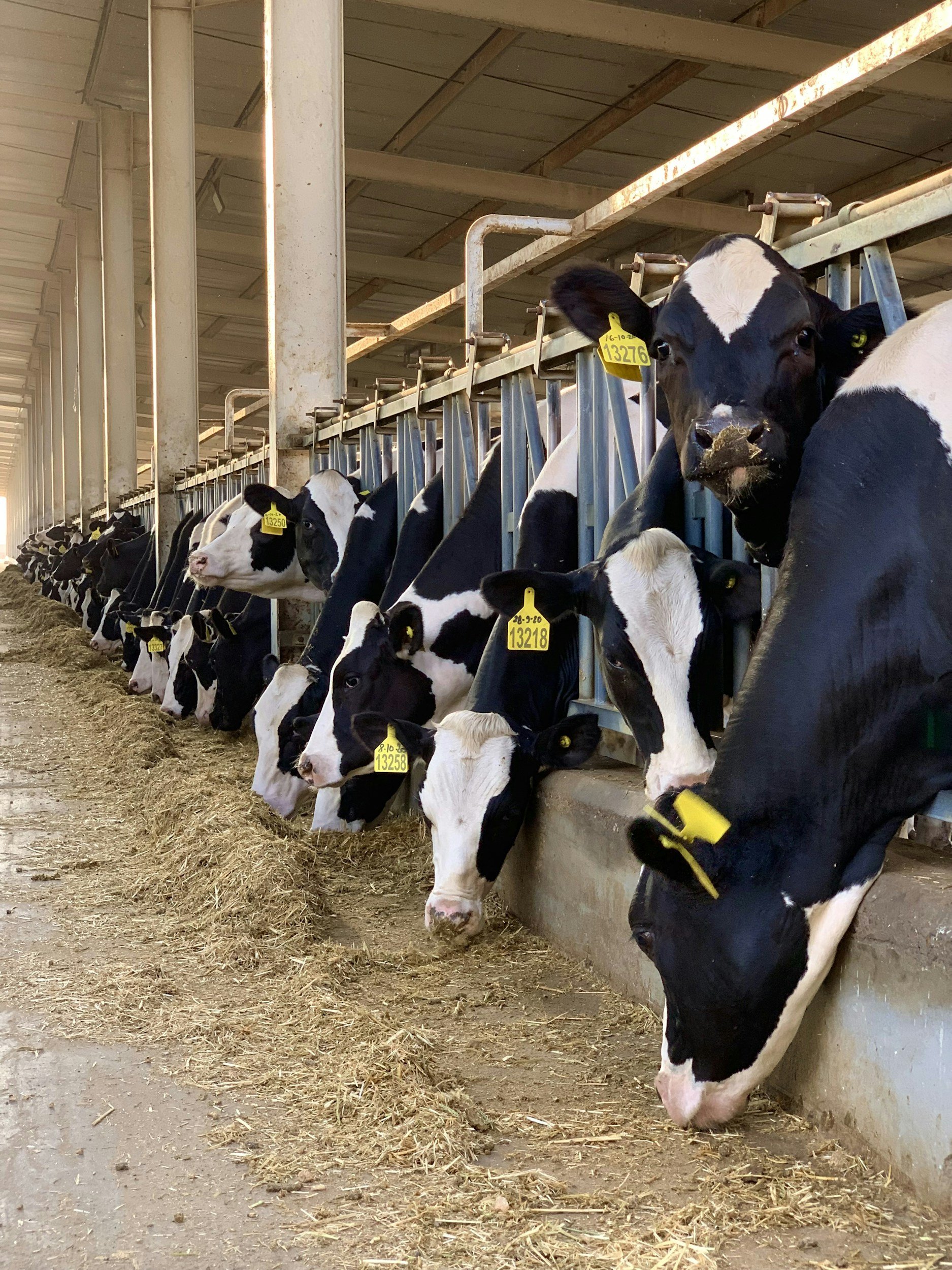
The Situation: Medium to large agricultural estates are currently navigating a highly volatile market for essential physical inputs, driven by compounding geopolitical and regulatory shifts. The Agricultural Industries Confederation (AIC) has issued severe industry-wide alerts for the 2026 season, warning that new EU tariffs on Russian products and the complex rollout of the Carbon Border Adjustment Mechanism (CBAM) threaten to heavily constrain global fertiliser availability. Simultaneously, operational water security is being actively destabilised by the Environment Agency's "Restoring Sustainable Abstraction" reviews, which threaten to introduce strict hands-off flow restrictions or entirely revoke existing abstraction licenses across East Suffolk to protect conservation areas like the Broads SAC. Compounded by global conflicts driving up agricultural fuel and feed costs, estates relying on just-in-time procurement face an acute enterprise risk of input starvation or severe price gouging.
How we help: We provide highly targeted Situation Updates that track the precise macroeconomic and regulatory variables threatening your specific resource pipelines. By continuously monitoring international fertiliser tariffs, CBAM implementation schedules, and the trajectory of regional Environment Agency enforcement actions, we deliver the foresight required for you to confidently forward-purchase critical inputs, lock in fuel contracts, and restructure water management strategies long before supply bottlenecks or regulatory hard-stops materialise.
-
![]()
Global Logistics & Supply Chain Resilience
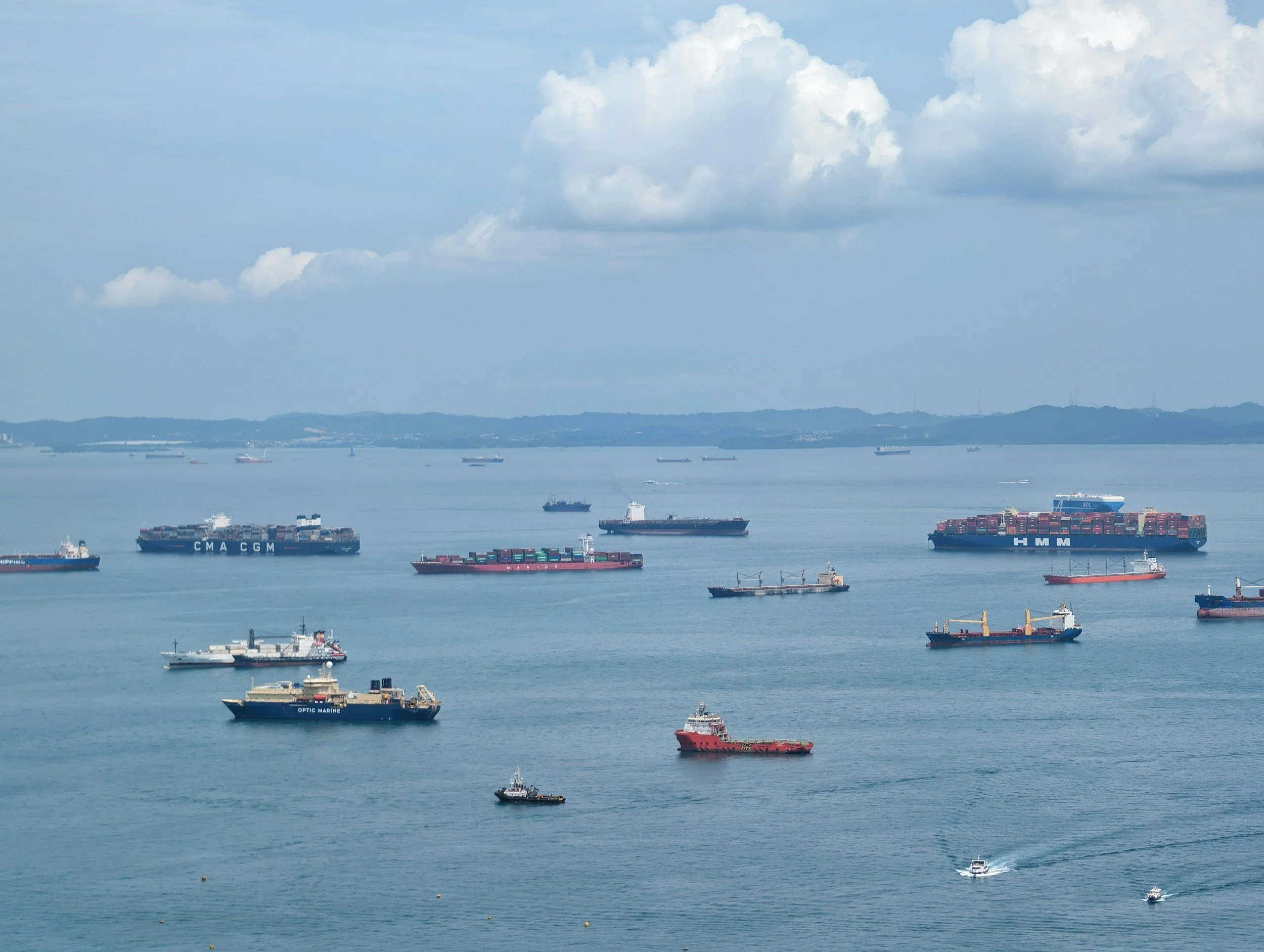
The Situation: Structural geopolitical volatility and large-scale capital realignments have fundamentally altered international trade predictability for logistics operators. The UNCTAD Review of Maritime Transport indicates global maritime trade growth is stalling at 0.5% due to geopolitical friction and long-distance rerouting that has increased tonne-mile metrics by approximately 6%. Compounded by constantly shifting tariff landscapes initiated by US policy and the proposed £22.8 billion acquisition of Hutchison Port Holdings by the MSC-BlackRock consortium, logistics operators face sudden, unpredictable shifts in freight rates and network planning. Supply chain reliability is no longer just a logistical friction; it is a critical enterprise risk.
How we help: We provide highly targeted Situation Updates that continuously track these macro-geoeconomic shifts and port ownership realignments. By monitoring tariff policy trajectories and the operational integration of major consortiums, we deliver the foresight required for logistics directors to dynamically adjust pricing models, diversify origin-destination networks, and protect margins against asset underutilization well ahead of the market curve.
-
![]()
Advanced Technology & AI Integration
The Situation: As artificial intelligence rapidly reshapes operations from predictive maintenance tools to the deep learning Veronica Terminal Operating System in logistics, technological adoption is creating acute vulnerabilities. Firms must balance the integration of in AI into operations against warnings from the National Cyber Security Centre (NCSC) regarding a widening gap between AI-driven threats and national infrastructure resilience. Misjudging these cybersecurity thresholds or failing to protect cloud-native Operational Technology (OT) networks risks severe multi-day outages, data encryption from ransomware, and restricted market access.
How we help: We provide continuous intelligence tracking of the evolving industrial cyber threat landscape and technical compliance standards. By anticipating advanced persistent threats and monitoring NCSC advisories specific to AI and OT environments, we allow scaling tech and manufacturing firms to safely implement zero-trust architectures, ensuring AI integration aligns with future security mandates without facing sudden operational lock-out.

Contact
The first step is to understand your organisation, the environment in which you operate, and the decisions you are carrying.
From this, the structure of an appropriate intelligence function can be defined.
If this is relevant to your current situation, I would be glad to speak.

Executing High-Stakes Capital and Infrastructure Trade-Offs
Decision Trade-off Assessment
Committing significant capital to new infrastructure, technology platforms, or major supply chain reconfigurations carries profound, often hidden, secondary risks. Before irreversible structural decisions are finalized, leaders require rigorous, objective scrutiny. We apply advanced intelligence tradecraft to examine proposed decisions, utilizing structured qualitative analysis and operational modeling. By mapping out the exact consequences of acting, delaying, or abstaining, we identify unintended operational knock-on effects and financial vulnerabilities before they occur, ensuring your capital allocation is resilient against future market shocks.
The Deliverable
The Decision Trade-off Assessment provides an objective, multi-dimensional evaluation of your irreversible structural investments. Utilizing advanced analytical methodologies demonstrated in complex international initiatives such as the Rexus Project, we model the cascading impacts of your decision across disparate, interconnected sectors. You receive a clear, evidence-based assessment that maps how committing capital to a specific initiative alters your overall risk profile, allowing you to visualize secondary financial vulnerabilities and operational consequences before capital is deployed.
Application in the Current Situation
In East Anglia, trade-off analysis is currently critical for capital-intensive sectors. The offshore energy supply chain must weigh massive capital deployments into wind and hydrogen infrastructure against the unfinalised configurations of the National Grid (such as Sea Link) and shifting government policies. In agriculture, large estates face decisions like investing millions in engineered reservoirs while the Environment Agency actively reviews abstraction licenses, creating a severe risk of stranded assets. Through objective trade-off modelling, I help leadership teams evaluate these proposed investments, ensuring that capital is deployed resiliently and not trapped by unforeseen regulatory or infrastructural constraints.
Sector Close-Up
-
![]()
Offshore Energy & Infrastructure
The Situation: The UK is undergoing a generational energy transition, requiring unprecedented capital investment into projects like the 3.2GW Sizewell C nuclear build and the 2GW Sea Link subsea interconnector along the Suffolk 'Energy Coast'. However, organizations looking to service this £122 billion pipeline face immense strategic risk navigating the Nationally Significant Infrastructure Project (NSIP) regime. They must commit heavy capital while facing uncoordinated "whack-a-mole" development patterns, severe delays in Development Consent Orders (DCOs) costing approximately £1.5 million per month, and novel Regulated Asset Base (RAB) funding structures.
How we help: Before an engineering or maritime firm commits millions to scaling its operations, we rigorously model the strategic trade-offs of the local energy landscape. We assess the risks of unfinalised network designs, local planning objections, and intense supply chain competition, ensuring your capital is deployed efficiently and your final investment decisions are insulated against series effect delays and stranded assets.
-
![]()
Commercial Real Estate & Tax Zones
The Situation: Government-designated economic zones, such as the Freeport East initiative covering the Port of Felixstowe and Gateway 14, offer significant strategic catalysts designed to attract £5.5 billion in Gross Value Added (GVA). However, developers must balance these incentives against acute operational frictions, such as the "Nutrient Neutrality" crisis halting development in ecological catchment areas, and the stringent, costly digital record requirements of the Building Safety Act 2022. Securing long-term tenants is further complicated by severe regional infrastructure bottlenecks along major freight corridors.
How we help: We model proposed capital expenditure against the strict timelines of Freeport tax incentives and regional planning barriers. By evaluating up-front financing for site infrastructure against potential hard stops at the Building Safety Regulator gateways and navigating nutrient mitigation hierarchies, we maximize your return on investment before critical legislative deadlines expire.


Contact
The first step is to understand your organisation, the environment in which you operate, and the decisions you are carrying.
From this, the structure of an appropriate intelligence function can be defined.
If this is relevant to your current situation, I would be glad to speak.
Resolving Systemic Friction & Value Chain Vulnerabilities
Business Mapping and Flow Modelling
When organizational performance stalls despite heavy investment, the root cause is rarely a single departmental failure; rather, it is systemic friction across your wider value chain. Whether your enterprise is grappling with regional infrastructure bottlenecks, disconnected data silos, or highly complex operational dependencies, achieving efficiency requires total architectural visibility. We build comprehensive, structured representations of how your business actually functions, precisely detailing resource flows, information deficits, and physical points of constraint.
The Deliverable
Our Business Mapping and Flow Modelling service turns your complex operational web into a clear, testable architecture. We deploy advanced visual methodologies, including customized Sankey diagrams, to dynamically demonstrate the exact flow of resources and information through your organization. By referencing these flows against critical operational limits and infrastructure capacities, we pinpoint the precise locations of systemic friction and vulnerability. In its most advanced form, we turn your operational architecture into a working model, allowing you to test, stress, and refine structural interventions before live implementation.
Application in the Current Situation
Regional businesses are currently struggling to manage cascading threats where the source is multiple steps from impact. Manufacturing and logistics firms are highly exposed to the chronic disruptions of the A14 corridor and the Ely/Haughley rail bottlenecks, threatening just-in-time supply chain contracts. Similarly, highly consolidated agricultural operations face severe vulnerabilities where isolated data silos from precision field robotics fail to communicate, and resource flows are constrained by extreme weather volatility. By modelling these exact resource and information flows against critical regional infrastructure limits, I enable organizations to pinpoint their vulnerabilities, untangle operational bottlenecks, and test alternative routing tolerances before they impact the bottom line.
Is systemic friction hindering your operational output?
-
![]()
Advanced Manufacturing & Corporate Technology
The Situation: As manufacturers move toward smart factory models and integrate Artificial Intelligence (AI) to combat a regional deficit of 46,000 unfilled vacancies, technological adoption is outpacing secure governance. This creates highly vulnerable Operational Technology (OT) environments where misclassified human-machine interfaces run on disparate data silos, exposing physical production lines to advanced persistent threats. With ransomware targeting OT experiencing a 64% year-on-year increase, these hidden vulnerabilities threaten multi-day outages and severe digital supply chain compromises.
How we help: We build a comprehensive architectural map of how data, resources, and operational technologies actually flow through your manufacturing process. By identifying disconnected data silos and misclassified assets between your IT and OT networks, we allow you to restructure your digital pipelines, implement secure mesh networks, and establish a unified architecture before scaling automated technologies across the factory floor.
-
![]()
Regional Freight & Logistics
The Situation: Major distribution firms are increasingly hampered by fragile physical infrastructure, such as the structural issues facing the A14 corridor which carries 48% of the UK's container trade. Chronic disruptions, such as impending bridge bearing replacements and highway bottleneck, severely threaten the viability of just-in-time (JIT) supply chain contracts. These freight frictions lead to cascading delays, increased fuel consumption, and financial penalty clauses that erode margins in a sector already facing a 35% increase in vehicle acquisition costs.
How we help: We map your specific operational dependencies against regional physical infrastructure limits, such as yard utilization constraints and highway closure protocols. By turning your logistics network into a working model, we allow your planners to test alternative routing tolerances, pinpoint systemic last mile vulnerabilities, and build temporal contingencies that safeguard your margins against external gridlock.


Contact
The first step is to understand your organisation, the environment in which you operate, and the decisions you are carrying.
From this, the structure of an appropriate intelligence function can be defined.
If this is relevant to your current situation, I would be glad to speak.

Validating Structural Pivots and Enterprise Transformation
Bespoke Services
Sector-wide disruptions, such as the transition to clean energy, the integration of frontier technologies, or major shifts in public sector procurement, demand fundamental business architecture redesigns rather than incremental adjustments. However, executing a strategic pivot without destroying current revenue streams is highly perilous. For complex, rapidly evolving challenges that defy standard consultancy frameworks, we deliver targeted scenario development and bespoke intelligence. We validate your transformational roadmap, ensuring your new business model is structurally sound, economically viable, and optimally timed to capture emerging market share.
The Deliverable
For challenges requiring architectural shifts, our Bespoke Intelligence Services provide a highly focused, custom-built intelligence product that pressure-tests your strategic roadmap. You receive an exhaustive scenario development brief that validates your enterprise transformation against projected future states. This ensures that your leadership team has a verified, actionable blueprint to bridge the gap between your current operating model and your future strategic destination.
Founder Experience & Application
Complete structural pivots are currently mandatory across multiple regional sectors. With the upcoming 2028 Local Government Reorganisation in Suffolk, public sector contractors must completely overhaul their bidding strategies to align with the new unitary authorities. Likewise, agricultural estates are attempting to transition from high-input commodity farming to natural capital markets and agroforestry—a perilous shift requiring them to navigate the gap between lost subsidies and the technical difficulties of verifying soil carbon sequestration. Through bespoke scenario development, I pressure-test these transformational roadmaps, providing executives with a verified blueprint that bridges the gap between their current operations and their future strategic destination.
Sector Close-Up
-
![]()
Large-Scale Agriculture & Estates
The Situation: The agricultural sector is being forced through a permanent, structural transition characterized by the withdrawal of legacy Basic Payment Scheme (BPS) subsidies and impending inheritance tax reforms. Large estates are attempting to pivot toward natural capital markets, landscape-scale rewilding, and integrated agroforestry to replace lost revenue. However, they face massive technical hurdles, such as accurately measuring and proving the additionality and permanence of soil organic carbon (SOC) sequestration to the exactitude required by corporate buyers, risking accusations of greenwashing.
How we help: We provide targeted scenario development to pressure-test your estate's transformational roadmap against the volatility of Environmental Land Management schemes (ELMs). We model the long-term financial viability of transitioning to extensive ecological management against the harsh realities of emerging carbon markets and shifting tax liabilities, ensuring you can transition without destroying your core revenue streams in the interim.
-
![]()
Public Sector Contracting & Civil Engineering
The Situation: Structural reorganizations within local government instantly alter the landscape for private construction businesses holding massive public sector contracts. As regions propose consolidations of multiple councils into a single ‘One Suffolk’ unitary authority model, legacy procurement pipelines and district-level relationship networks threaten to become immediately obsolete. Contractors must now navigate centralized procurement frameworks that apply strict 10% to 20% quality score weightings for ‘Social Value,’ requiring firms to mathematically prove localized economic multipliers.
How we help: Through bespoke scenario development, we map the incoming shadow authority structures and anticipated funding consolidations. This intelligence allows regional civil engineering contractors to completely restructure their bidding strategy, effectively quantify measurable added social impact to survive panel scrutiny, and forge the necessary partnerships well ahead of their competitors in a centralized market.


Contact
The first step is to understand your organisation, the environment in which you operate, and the decisions you are carrying.
From this, the structure of an appropriate intelligence function can be defined.
If this is relevant to your current situation, I would be glad to speak.